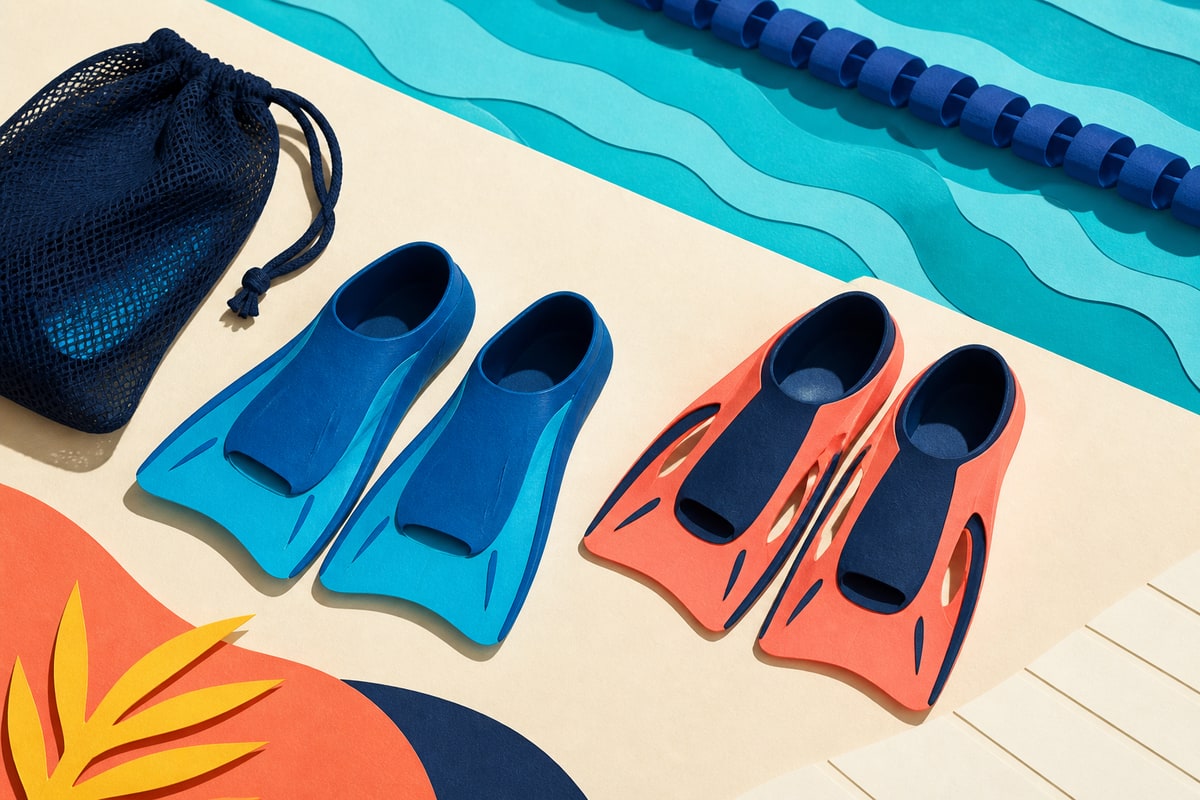
The best swim fins for training match the swimmer’s foot, kick tempo, stroke, and reason for using fins. A long snorkeling fin, a short-blade pool fin, and a four-stroke training fin may all add propulsion, but they do not teach or load the kick in the same way.
For most competitive lap swimmers, a secure short-blade fin is the best default. It adds enough propulsion to support body position and drill speed without slowing the kick into a long, sweeping motion.
Quick answer
Choose the job before the brand.
| Training need | What to look for | Main tradeoff |
|---|---|---|
| Fast flutter or dolphin kick | Short, relatively firm blade | More load on the legs and ankles |
| Technique support or newer swimmer | More flexible short blade | Less resistance and power emphasis |
| Breaststroke or IM work | Fin explicitly designed for all four strokes | More specialized shape and feel |
| Maximum ankle freedom | Open-heel design | Heel fit can feel less contained |
| Soft, contained foot pocket | Silicone closed-foot design | Can feel heavy or tight on some feet |
The fin should stay on during a push-off without crushing the toes or rubbing the heel raw. If a swimmer is between sizes or has a wide foot, the manufacturer chart and return policy matter more than a generic shoe-size conversion.
Short fins versus long fins
Short-blade fins are the better default for competitive pool training because they encourage a quicker kick rhythm. FINIS describes its Zoomers Gold as a short blade intended to promote shorter, faster kicks, while arena describes the Powerfin Pro II around kick speed, control, and power training.
Longer blades create more leverage and usually more obvious propulsion. That can help a newer swimmer feel body position or keep moving through a drill, but it can also produce a slower rhythm that does not resemble normal swimming as closely.
Choose short blades when: the goal is kick speed, conditioning, fast drill work, or a rhythm that stays closer to pool swimming.
Consider longer, softer blades when: the swimmer needs more assistance maintaining momentum or the coach has assigned them for a specific drill.
How swim fins should fit
A training fin should feel secure before the swimmer pushes off. It should not fold the toes, numb the foot, or require the swimmer to curl the toes to keep it on.
Check four areas:
- Toe room: toes should not be painfully compressed against a closed pocket.
- Instep pressure: the top of the pocket should hold the foot without creating numbness.
- Heel security: the heel should not repeatedly slide out during kicking or turns.
- Skin movement: a little water is normal; repeated rubbing in one spot predicts a blister.
Material alone does not determine comfort. Silicone can feel smooth and consistent, while natural rubber may break in differently. The pocket shape, opening, and width determine whether either material works for a particular foot.
Do not assume the swimmer’s regular shoe size transfers cleanly across brands. FINIS notes that some of its pockets run narrow and recommends sizing up when a swimmer is between sizes or has a wide foot. TYR publishes separate men’s and women’s equivalents for the Stryker. Recheck the chart for the exact model rather than relying on an old pair.
Models worth comparing
FINIS Zoomers Gold
Zoomers Gold use a short natural-rubber blade and a closed heel. FINIS positions them for shorter, faster kicks, cardiovascular conditioning, and leg-strength work.
Best for: swimmers who want a familiar short-fin format for flutter kick, dolphin kick, and longer kick sets.
Watch for: the narrower foot-pocket guidance, the exact size band, and whether the swimmer wants more or less blade stiffness.
arena Powerfin Pro II
The Powerfin Pro II uses a short silicone blade, an open heel, and separate left and right shapes. Arena emphasizes ankle flexibility, fast kicking, and control.
Best for: experienced swimmers who want a secure, performance-oriented fin while keeping the heel and ankle relatively free.
Watch for: left-right orientation, a different feel from closed-pocket fins, and whether the swimmer’s ankle mobility tolerates the added load.
TYR Stryker silicone fins
The Stryker is a short-blade silicone fin with a closed foot pocket. TYR describes it around short, quick leg-and-foot movement and a natural flutter-kick flow.
Best for: swimmers comparing a contained silicone pocket for routine team practices and kick sets.
Watch for: the brand’s gender-specific shoe-size equivalents and pressure across wider feet.
FINIS Positive Drive fins
Positive Drive fins use a short, wide, asymmetrical blade and an adjustable heel strap. Unlike ordinary flutter-kick fins, FINIS specifically designs them to create propulsion in all four competitive strokes, including breaststroke.
Best for: IM swimmers, breaststrokers, and practices that use fins across several strokes.
Watch for: correct blade orientation, strap fit, and the specialized movement compared with a conventional short fin.
Match the fin to the set
Fins should make a drill more specific, not simply easier.
- Kickboard sets: use a short fin when the goal is faster kick rhythm or conditioning; keep the body line long instead of lifting the head and collapsing at the hips.
- Streamline and underwater work: use a secure fin that will not shift during the push-off, then keep the kick within the coach’s intended amplitude.
- Side-kick and rotation drills: a moderate short blade can add enough movement to let the swimmer focus on alignment.
- Breaststroke or IM sets: use a model the manufacturer identifies for those kick patterns; ordinary straight-blade fins are not automatically appropriate for breaststroke.
- Recovery swimming: fins can reduce the effort needed to hold body position, but extra resistance is still extra load. Easy should remain easy.
Pair the decision with the kicking-drills guide instead of treating the fin itself as the workout.
Common buying mistakes
Buying snorkeling fins for pool training
Long recreational fins can be useful in the right setting, but they change kick rhythm and take up more deck and bag space. A swimmer assigned short fins should buy short fins.
Choosing only by softness
A soft pocket can still rub if the shape is wrong. A firmer fin can still fit comfortably if the pocket matches the foot. Fit must be checked while kicking, not only while sitting on a bench.
Sizing up to stop pressure
A larger fin may solve toe pressure and create heel slip. Compare another model or pocket shape before accepting a loose fit.
Using fins through pain
Normal training effort is different from sharp ankle, foot, knee, or Achilles pain. Stop the set and talk with the coach or an appropriate health professional rather than using the fin to force range of motion.
Care and bag setup
Rinse fins with fresh water, let them dry out of direct heat, and avoid leaving them folded under heavy gear. Carrying fins in a ventilated mesh bag keeps pool water away from dry clothing and prevents the blade from being bent inside a crowded backpack.
The swim-bag guide explains why many swimmers separate wet training equipment from meet-day clothing and electronics.
Training fins usually stay in the practice bag unless the coach asks for them during meet warm-up. The swim-meet packing checklist keeps race essentials ahead of optional training gear.
Frequently asked questions
Are short or long fins better for swim training?
Short fins are usually the better default for competitive pool training because they support a faster kick rhythm. Long fins can provide more propulsion and may help with body-position drills, but they create a different leverage and tempo.
Should swim fins be tight?
They should be secure, not painful. The fin should stay on through kicking and push-offs without numbness, toe crushing, or repeated heel rubbing.
Can you use regular fins for breaststroke?
Do not assume so. Conventional straight-blade fins are built mainly around flutter and dolphin kicking. Use a model specifically designed for breaststroke or all four strokes when that is the assigned goal.
Are silicone fins better than rubber fins?
Neither material is universally better. Silicone often feels smooth and consistent; natural rubber can offer a different flex and break-in feel. Pocket shape and correct sizing have a larger effect on comfort.
Bottom line
Start with a secure short-blade fin, then choose the pocket, heel, material, and stroke compatibility that fit the swimmer’s actual training. FINIS Zoomers Gold, arena Powerfin Pro II, and TYR Stryker offer different short-fin fits and materials; FINIS Positive Drive is the more specialized four-stroke option. The right choice is the fin that stays on, supports the assigned rhythm, and disappears into the work instead of becoming the problem.
A note from Nikki
What I looked at
I compared blade length, material, heel design, sizing, and intended use using manufacturer details, then matched those differences to common training goals.
What can vary
I have not personally tested every fin listed. Foot shape, ankle mobility, coaching goals, and model sizing vary, so use the current manufacturer size chart and return policy before buying.